

A couple of years ago I came across the table below and shared it as a joke to my Facebook page:
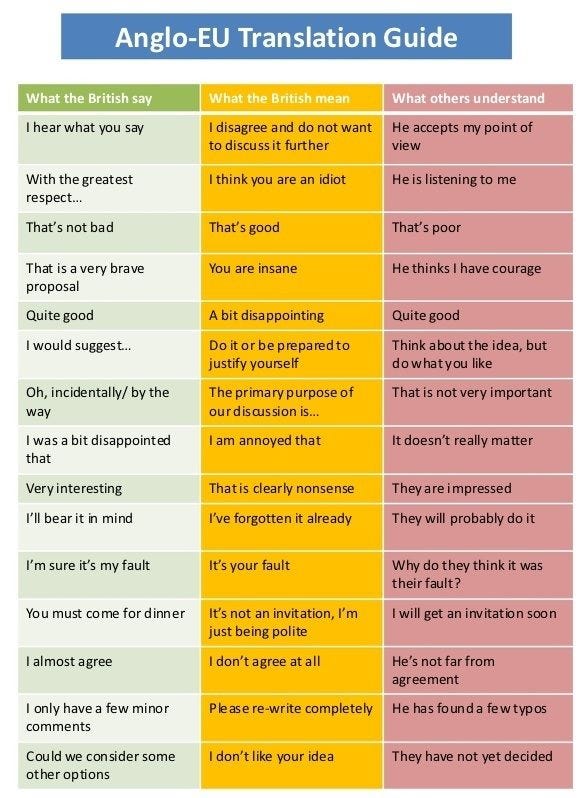
Several international friends who live in the UK responded saying that while they recognised that it was meant satirically, it is an accurate portrayal of British humour that either they currently found difficult or took a long time to get used to. “Why can’t the Brits just say what they mean?”
It isn’t just the Brits who make use of context, subtlety, sarcasm, and double entendre in conversation. So how can we know when to take things literally? That, is where cultural intelligence comes in.
Over the last few weeks I’ve been digging a bit deeper into Cultural Intelligence. My colleagues and I run cultural intelligence workshops for University of Surrey staff and I want to make sure we’re engaging with up to date ideas and research. You can find all the posts for cultural intelligence and start from the beginning here: click me
As I’ve highlighted in the previous posts, Cultural Intelligence (CQ) is understood to be made up of four capabilities, Drive, Knowledge, Strategy, and Action. It is impossible to know all of the subtleties and variations of communication in all cultures across the globe so specific cultural knowledge will only get you so far. It will be helpful if you are visiting only one part of a country, but less so if you work in a team or organisation made up of many cultures. The knowledge that is helpful in these instances is a more general understanding of the spectrum that cultures fall within. CQ Strategy is also needed for adapting your behaviour and communication to better communicate with those around you.
As discussed in the last post, Erin Meyer (author of The Culture Map) highlighted several dimensions of culture and several could have been labelled “Communication". In future posts we’ll look at the more foundational ideas that Erin Meyer built from (see Hofstede) but for now we’ll use her model. In her model she highlights the dimension of Feedback which has a spectrum of Direct vs Indirect Negative Feedback. While “feedback” may limit thinking to moments where you are being reviewed for the quality of your work, this can be expanded to more general moments of disagreement, responding to another person’s behaviour, or responding to an invitation or request.
As we start to explore this spectrum, reflect on the following questions:
How likely are you to tell someone explicitly that they are “wrong” - be it in a statement or a behaviour?
How easily can you say “no” to an invitation or request?
Does this likelihood change if they are older or younger than you?
If the likelihood you can tell someone explicitly that they are “wrong” or “no”, then you are more likely to lean to a more direct means of feedback. If age doesn’t change this, then you are more likely in an egalitarian1, low context2 culture. If you find that you are likely to soften the feedback (“I wonder if we might look at some other options?”), and age does affect your response further, then you are more likely leaning to a high-context, hierarchical culture that prioritises indirect communication.
Having reflected on your own responses to the two questions above, think about others in your workplace, friendship circles, or family and how they might respond. If you aren’t sure how they’d respond, ask them. Have a conversation exploring how their cultural background might influence their preferences.

Direct communicators often prioritise the “plain” meaning of words and see double-meaning or adapting to context as confusing at best or deceptive at worst. Assumptions are dangerous and silence shouldn’t last for long. To a direct communicator, communication is for information sharing and getting things done. Honesty and truth are values that must be upheld no matter if it affects someone’s feelings (see “facts don’t care about your feelings”). Trust is built through words and actions matching, so if a direct communicator hears “I’d like to be there” as a response to a party invitation, then they are very likely to be disappointed when the person doesn’t show.
Indirect communicators prioritise relationship over the plain meaning of words. The purpose of communication is for harmony, saving face, and avoiding conflict. Due to the prioritising of relationship, truth and honesty are secondary, even to the extent that one might aim to say what is expected of them, not what they actually think. Where truth might hurt, it must be softened to avoid humiliation and allow the other person to save face. The context of the communication is important and this often requires shared assumptions. In cultures where indirect communication is prevalent, it tends to be difficult for outsiders to feel connected until the subtleties of communication are understood.
Are you a direct or indirect communicator?
As you can see, if you have two people at opposite ends of the spectrum of communicating, it is going to take some self awareness and translating, and quite possibly some conflict or offence before there is a close relationship. Context and directness both have an impact on how people build trust, make decisions, persuade others, and their understanding of leadership.
There is an added complication to this paradigm in that directness can change in a single culture depending on the context. In the UK there is a general understanding that words used have a plain meaning, however, as can be seen in the table above this just isn’t the case and both indirect cultures and more direct culture find the UK culture difficult to adjust to. This is particularly the case when it comes to humour and feedback. Sarcasm and irony are commonly used as humour and remarks such as “that’s brave” actually mean something ranging from “I wouldn’t do that if I were you” to “you’re insane thinking that is a good idea”.
What I have noticed, both being from the UK and in interactions with international students is that most of us who are brought up in an indirect culture do have some built-in checks to find meaning. In the UK, “Not that bad” can be an understatement for not wanting to boost someone’s ego, or it could be softening feedback so as not to hurt feelings for something that really needs improvement. A common check is if you are given feedback on a presentation that, “its not that bad”, you might respond with “do you mean its not bad as in its decent or its rubbish?”3
The check is a natural response to indirect communication when you are integrated in the culture. However, if you are new to a culture, and especially when the language isn’t your first language, you can easily take the statement literally without realising the need to check.
For a comedic exploration of the British culture on “not too bad”, Bill Bailey gives a good rendition:
Whether you are a direct or indirect communicator, navigating conversations and feedback with those on other parts of the spectrum can be quite a challenge. Here are a few things to consider that can help you develop your cultural intelligence:
One rule that Erin Meyer offers in "The Culture Map” is “Don’t try to do it like them” when it comes to being direct. Even in cultures that tend to be more direct, it is possible to be too direct! If you need to give feedback and are not wanting to get it wrong, it is recommended to find someone who can help interpret what you need to say in a culturally appropriate way.
If a cultural interpreter isn’t available then start by reflecting on your own expectations with feedback and why you deliver it in a certain way. When you then give feedback, a brief explanation of why you are structuring it in the way you are can help pre-empt misunderstanding.
Asking questions of the person you are interacting with as to their expectations and what they find helpful when it comes to negative/constructive feedback also will help navigate culture clashes.
Developing cultural intelligence takes time and a lot of listening but the benefits are worth it4. In future posts I’ll be exploring how culture impacts views of leadership and decision making, and more. For now, I’ll conclude this post with my favourite quote from Erin Meyer’s book adapted for this post:
The [culturally intelligent person] learns how to adapt - to alter [their] behaviour a bit, to practice humility, to test the waters before speaking up, to assume goodwill on the part of others, and to invest time and energy in building good relationships.5
I am a coach working with people as they navigate cultural and life transitions.
For more about me click here.
I have not yet covered the power distance spectrum that frames the heirarchy vs egalitarian spectrum but you can find an introduction here if you want to jump ahead of my posts: https://www.rw-3.com/blog/cross-cultural-awareness-how-to-tell-a-hierarchical-from-an-egalitarian-culture
A reminder: Low Context means words are prioritised and tone and body language are less important. High Context means relationships are prioritised, tone, body language, and who is in the conversation impacts what can and can’t be said.
This check can often be done with humour or even repeating “not that bad” with a different tone to highlight “decent” or “rubbish” which doesn’t come across well when written down.
The original quote: “The sophisticated global manager learns how to adapt - to alter his behaviour a bit, to practice humility, to test the waters before speaking up, to assume goodwill on the part of others, and to invest time and energy in building good relationships.”