


One of the fundamentals for coaching, mentoring, supervising or even more therapeutic practices like counselling or psychotherapy, is being self aware. A wise man once asked the question,
“Why do you look at the speck of sawdust in your brother’s eye and pay no attention to the plank in your own eye?” Jesus, The Gospel of Matthew Ch. 7
Too often we see others as the problem or get invested in their problems when we ourselves have much bigger issues to sort out (see The Drama Triangle article below). Self-awareness helps us get a more accurate picture of where we fit in relation to the problem and how we can take responsibility for our part in the problem and move towards a solution. More often than not, changing our behaviour, decisions, and actions will be both far easier and more effective in sorting a problem than trying to fix everyone else.

Self-awareness is in part, knowing how you act and react in certain situations, or when certain topics are discussed. It is also in part, knowing your values and living them out as best as possible. However, a big part of self-awareness is taking time to listen to how others perceive you.
People think differently and see the world differently so what you say and do is perceived through the other person’s reality. You may think you are communicating and acting in a way that highlights who you are and your values but in reality, you are being perceived totally differently.
It requires some serious levels of humility to really engage with feedback about how you are perceived. It can be very easy to become defensive, to blame others for not understanding you, or that you didn’t mean to be X, Y, or Z. It is also not to be something you should ask of everyone - some people do think they should have a say in how you live your life even when they haven’t earned the level of trust required, but these folk tend to give it even when you haven’t asked so they can be filtered out.
I remember being put on a course when I was a teacher that was led by a coach. I don’t remember a huge amount from the sessions other than one grid that did give me a bit of a wake up call. It looked like the grid below:
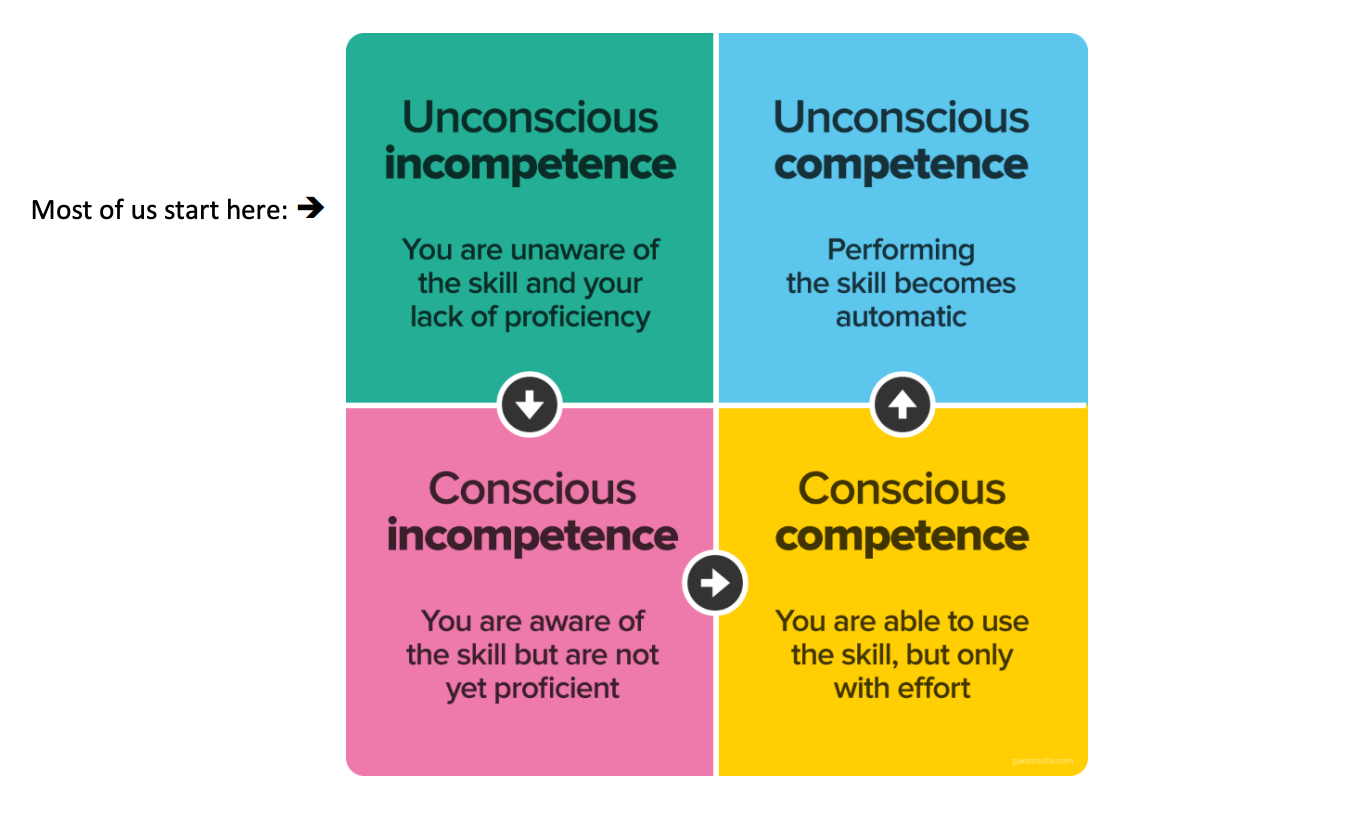
The grid is credited to Noel Burch who developed it in the 1970s. Most of us when learning anything will start at the top left and gradually move through the stages of competency. Some things, like driving or a sport, we’ll recognise our incompetence pretty quickly during a first attempt at the skill and be in the “Conscious Incompetence” stage. We may have been unconscious about the incompetence because we’d never engaged with the skill before but the moment we do, it becomes quite obvious we need to practice.
I believe most people, when made aware of their incompetence, be it through not playing a sport well or direct feedback from an instructor or line manager, will do their best to move through the competency grid. However, I have seen someone who believed themselves to be competent, ignore all the feedback they were given and remain stuck in the unconsciously incompetent box until they were moved on from their job. We can lie to ourselves so much that we refuse to align our self-perception with how people experience us.
How do we get ourselves into a place where we can hear the feedback we need to hear, ignore the feedback that is just noise, and move ourselves through to being competent - and in this case, competent in being self aware?
The first step, I think is reflecting on your own values. How do you want people to perceive you? What do you want to be known for? Is humility a part of your core values? Humility will help you hear helpful feedback even if it comes from an unhelpful source or in an unhelpful manner. I discuss the importance of values and integrity in the article below.

Once you know how you want others to experience you, it is time to reflect on how you are experienced. One resource to do this is called the Johari window. It is another grid that has four areas, the Open/Public Self, the Blind Spot, the Hidden Self, and the Unknown Self. The aim is to help you see how others see you, spot anything that is not known to yourself but known to others, and recognise what you are hiding from people.
I have personally found the “Unknown Self’ difficult to get my head around - how do we know what nobody knows and if you can write something in it then surely it becomes known? One explanation that I have found helpful is to think of it as the box of new experiences - the things that will become known when you try something for the first time or or do something out of your comfort zone that teaches you a new skill.
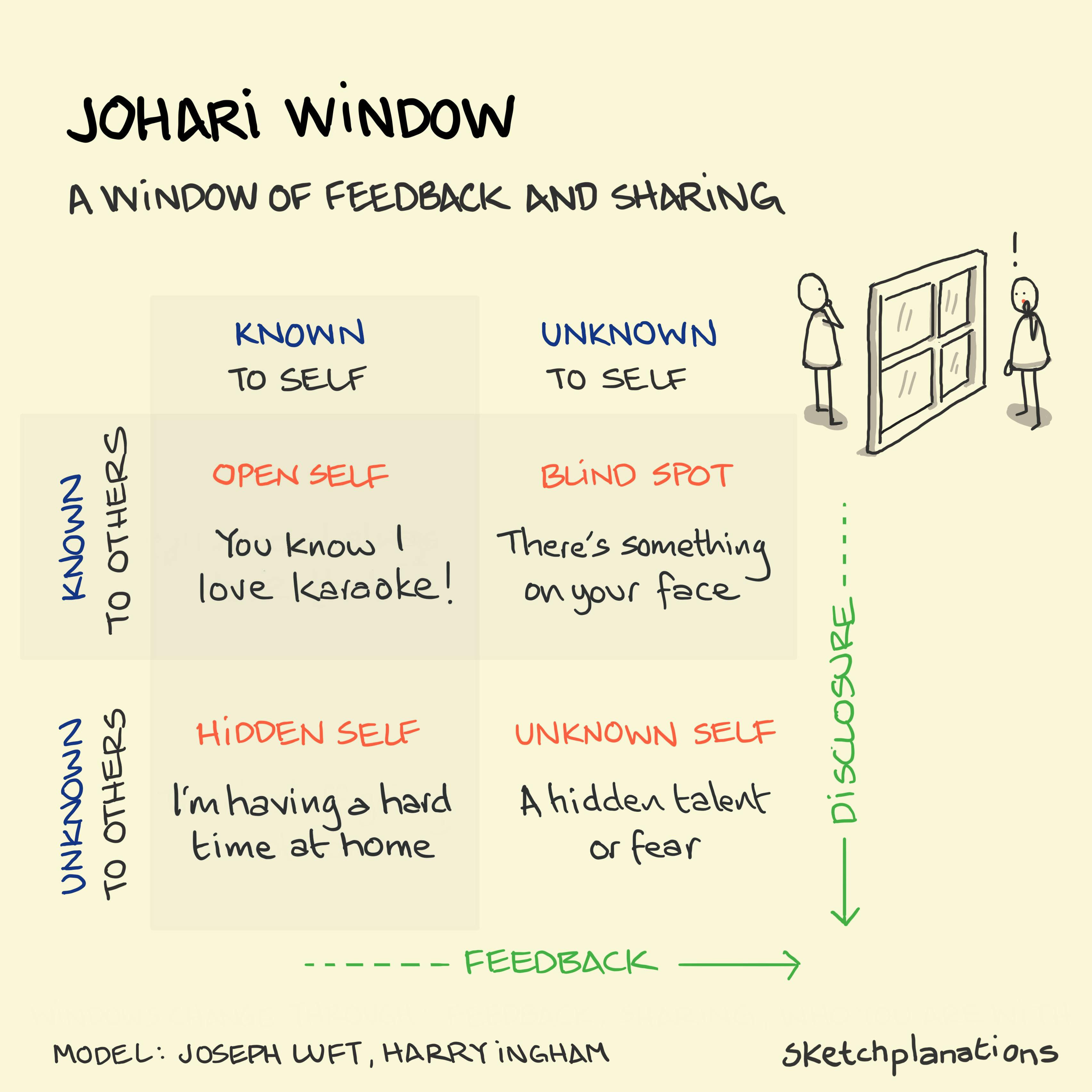
If you want to make use of the Johari window now, start by writing a list of words you would use to describe yourself. Then ask a group of people, perhaps colleagues, friends, family, or a mix of all three to share a few words (8-10 is a good maximum) that they think describe you.
Shared words go in the Open Self box. Words you used but others didn’t go into Hidden Self. Words others used but you didn’t go into Blind Spot. The Unknown Self box may well be empty but it gives you an opportunity to think about situations that made what was once unknown, known (i.e. it was unknown that you were afraid of heights until you tried bungee jumping).
Once you’ve done this task, take time to reflect on how big the windows are and ask yourself some questions like:
Are you more hidden to others than you thought?
Do you have more blind spots?
Or is everything known to you and others and all aligned?
What would you like to change and how will you go about changing it?
There are other resources for reflection and developing self-awareness that I’ll be discussing in future blog posts. Let me know what you think of the Johari window in the comments and if you want a little more about it, check out the video and link below.
Resources
A far more in-depth look at the Johari window including its history and further applications for teams and leaders: https://www.tsw.co.uk/blog/leadership-and-management/the-johari-window/
I found this super interesting and useful. Think I might use the Johari window!