


When in a community, it is too easy to deflect or ignore red flags especially when our personal experience has been so good up to that point. If the person in power is affirming our own conclusions, suspicions, or fears, then our brains can also work against us thinking critically. However when we do overcome the pressure to remain silent, standing up and raising concerns can come with its own cost.

DARVO is a model that helps us analyse an all too common harmful response when an individual raises concerns in a community. DARVO was developed with abuse in relationships in mind (see Resources below) but provides a helpful framework in other contexts. It is particularly pernicious in communities and organisations with a top-down structure of authority. This is where the average worker or member of the community have no means of checking the narrative of the person or group in authority. Talking to an excluded person would also mean their own position in the group or role is threatened. If you haven’t come across DARVO then it is worth reflecting on the image below.
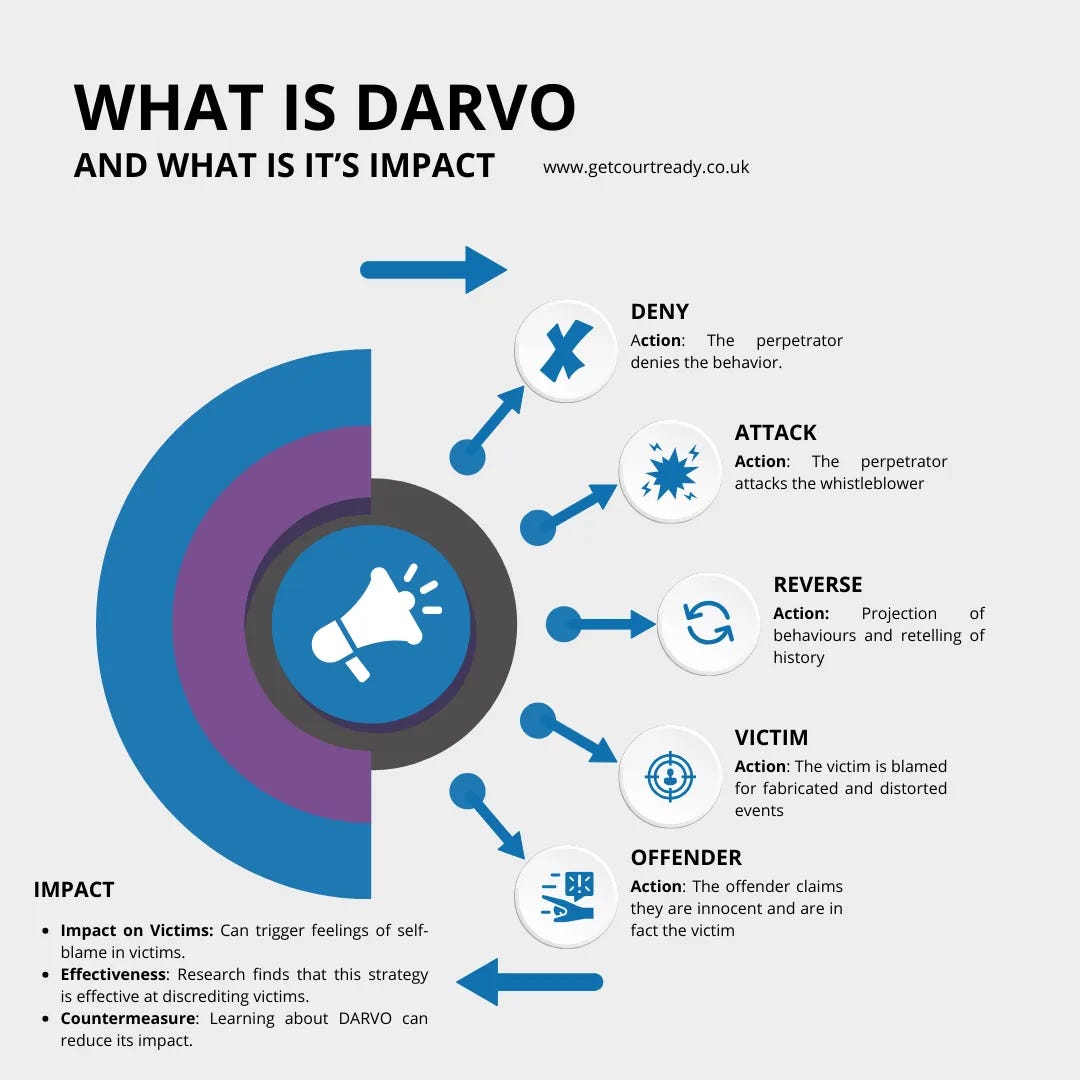
The acronym stands for Deny, Attack, Reverse Victim and Offender. Denial could be explicit or implicit through deflection and distraction. Whistleblowers and victims are often accused of trying to tear a good person or organisation down. Sadly there is often a cost to standing up to bullies or people in positions of power who are content to use misinformation or make claims with no evidence to push their cause and gain more power.
In organisations and faith communities, DARVO is used to distract supporters from believing and sympathising with those who have been persecuted or harmed by the person in power. It flips the script on who the real victim is and while the person in power controls the narrative to the in-group, the actual victim is excluded from having a voice to contradict the labels and accusations being spun against them. The person seeking accountability and transparency is labelled bitter or angry and the in-group close around and defend their leader. The labels against the victim help justify ignoring any facts or evidence. Those within the in-group emphasise that their leader has “done so much good”, “didn’t mean to hurt anyone”, has “always been good to them”, “you’re not perfect”, or any other number of deflective moves.
This isn’t to say that leaders cannot be victims, nor that DARVO only flows down a hierarchical structure. A group may gain some power of influence within a community and spin a narrative about a leader. Many leaders have found themselves excluded because they are the whistleblower or have tried to bring about accountability that others in the community aren’t comfortable with. When discussing whistleblowers, I have found many people (including myself in the past!) assume them to not be in positions of influence or power themselves. This isn’t always the case!
Another area that DARVO can be used is in the context of governmental leadership and politics. Without using names, there are prominent examples of claiming to be persecuted to remain in a position of power or gain sympathy from supporters. It’s a particularly powerful tool when the supposed persecutors remain unable to defend themselves, or are an undefined enemy where it’s impossible to prove “they” don’t exist.
However, when policies are highlighted as being racist, actions by law enforcement are specifically designed to act against minority groups - citizens or otherwise, or comments are xenophobic, politicians will hypocritically claim that words have power and can lead to violence against them. They’ll cry “foul” at having their character smeared rather than deal with the issues being raised. Those who agree with or voted for a particular person will often defend and deflect their party or person without engaging in the issues being raised - often by going on the attack.
How do we defend against DARVO?
The first place to start is by reflecting on our own ability to use DARVO, even unwittingly. I think it is a human tendency to hate being held accountable and to jump straight to denial and attack. I’ve seen children do this when told to apologise for an action they blame the other child for telling on them and accuse the adults in the room that they’re being mean. Sadly many adults don’t seem to grow up but instead become more adept at manipulating those around them to take their side. Being self aware enough to recognise mistakes seems to be a skill that is lost the further up a person rises.
While reflecting on our own actions, think about how you act as a member of a community, political persuasion, or an organisation. If we have a loyalty to a leader or person in power, or are just close friends with them, we can dismiss issues raised because the issue raised is so far from our own personal experience. We can even find ourselves going on the attack because we cannot easily handle evidence that contradicts our experience or our firmly held beliefs, particularly if it comes from a source that might deliver the information in a way that doesn’t feel safe.
If you are faced with DARVO yourself, then making records is a good place to start. Comparing words and actions, recording both where possible, helps combat the feeling of being gaslit which often accompanies the reversal of victim and offender roles. Find people who can walk with you through it, comfort you through the painful times and help you take responsibility for how you move forward.
If in an organisation, look for whistleblower policies and procedures and any independent bodies that might be supportive.
If in a faith community, finding resolution depends on the community structure. From my background in churches, some are improving their ability to hold leaders who utilise DARVO and NDAs accountable, but sadly many are failing to learn from the growing number of stories of pain and exclusion coming from whistleblowers. Many whistleblowers, victims, or people asking questions around accountability and transparency, have found themselves excluded from a community because a leader’s ego has been bruised and their supporters don’t want to hold them accountable.

For those of us watching people in prominent positions attempting DARVO en masse, there may not be much we can do other than to highlight to those around us the contradictions between what is being said and what is being done. We can share information about frameworks like DARVO or the Drama Triangle and use them to analyse where leaders/followers are trying to win sympathy or claim a victim status. We can certainly vote accordingly when the time comes. Those currently in positions of power and influence claiming to be victimised while attacking groups of people who have no voice may likely be protesting too much.
Have you experienced DARVO? Has it been resolved? How did you work through it?
When someone raises an issue, be it political or about a leader you respect, do you jump to defend or do you remain curious?
Does any of this ring true for a situation you are currently in? If you would like someone to talk to or help you think through next steps then you’d be very welcome to get in touch.
Resources
DARVO was coined in 1997 by Jennifer Joy Freyd, PhD. For more of her research you can visit her website here: https://www.jjfreyd.com/darvo
Wade Mullen has worked with many Christians navigating abuse within their faith communities. He has written about DARVO and the impact on whistleblowers here:

This was really good, thank you.. Listening to 'Something's Not Right' by Wade Mullen at the moment. Such a helpful book.