


Each person is unique and yet we all have patterns of behaviour when it comes to relating to each other that can be summarised through frameworks and models. One such framework developed to help analyse relational dramas is Transactional Analysis.
Eric Berne developed Transactional Analysis (TA from here on out) in the 1950’s and published his book, Games People Play in the 1960’s. The next blog post or two will be an introduction to the basic concepts of TA as I understand them in the hope that explaining it will help it sink in to my own brain.
One of the main conclusions from the Drama Triangle that I’ve discussed previously is the need for us to take responsibility for our own situations and behaviours. We’d like to be able to change others, and some are quite adept at manipulation, but it is much easier, and less ethically problematic, to focus on our own behaviours. TA is a framework that can help us do that.
Ego States
Eric Berne breaks down the psychological states that we interact with the world and others into three categories: Parent, Adult, and Child.
Parent - You interact with the world in a similar manner as one of your parents (or parental figures) would.
Adult - You interact with the world in a rational and reasonable way, able to make objective decisions, recognising emotions but able to regulate them.
Child - You interact with the world in a similar manner as you would when you were a child.
While the aim of interacting with TA is to strengthen the adult state, this does not mean that parent and child states are always negative. We all operate in these different states but must recognise that if someone is responding to a situation or issue in a child state, i.e. they are currently overwhelmed by emotion, it is not going to be helpful to expect them to make an objective and rational decision. To interact with their adult state, they must first recognise and regulate the emotions. This may require a short pause or an alternative course of action depending on the situation.
Eric Berne also clarifies,
“The word childish is never used… since it has come to have strong connotations of undesirability… Actually the child is in many ways the most valuable part of the personality, and can contribute to the individual’s life… charm, pleasure and creativity.” (Berne, Games People Play)
To bring further clarity to the model, it can be laid out in the structural diagram below:
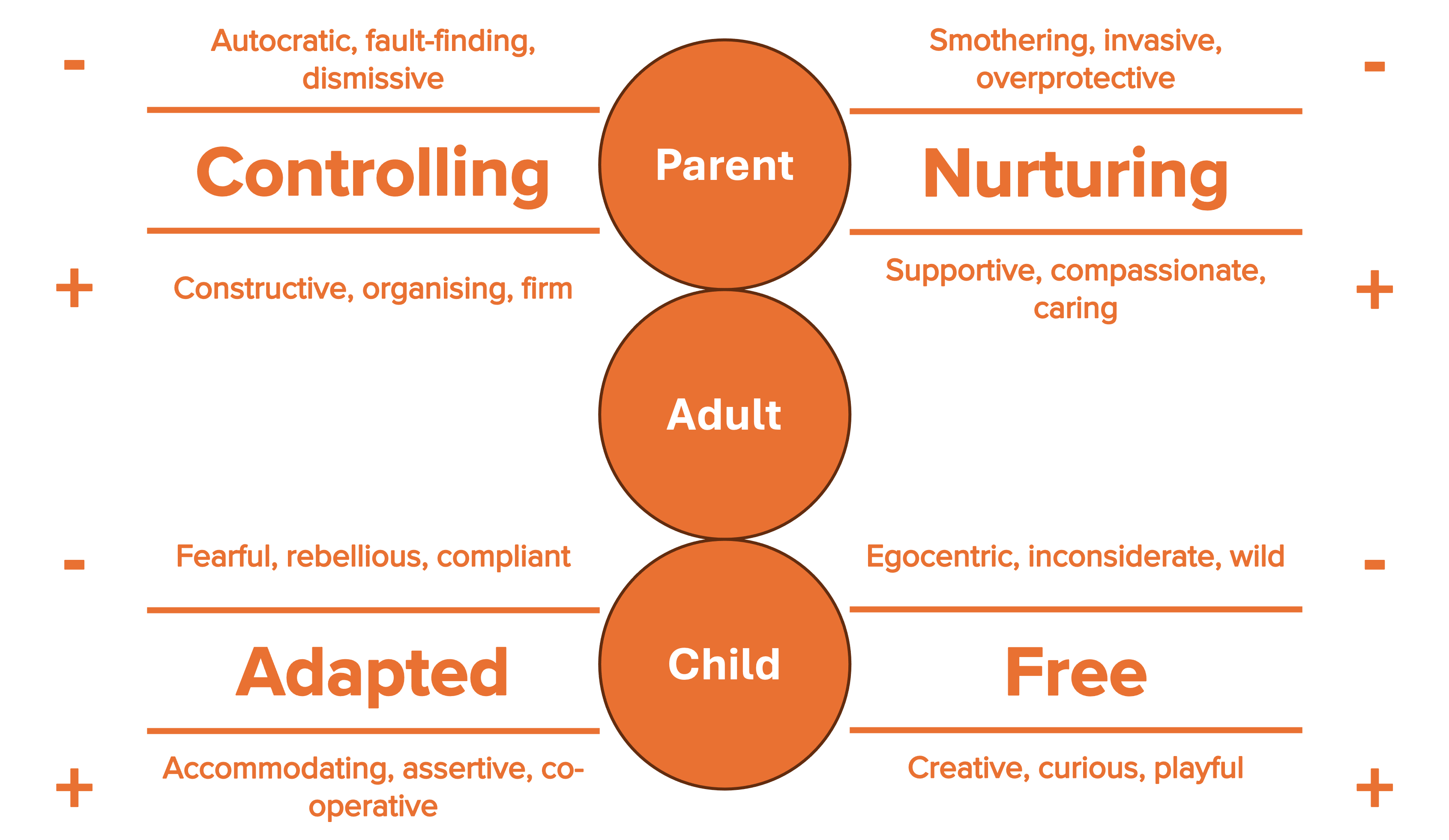
This diagram highlights that both parent and child states have positive and negative aspects to them while the adult state has access to all information and is not divided in the same manner.
Transactions
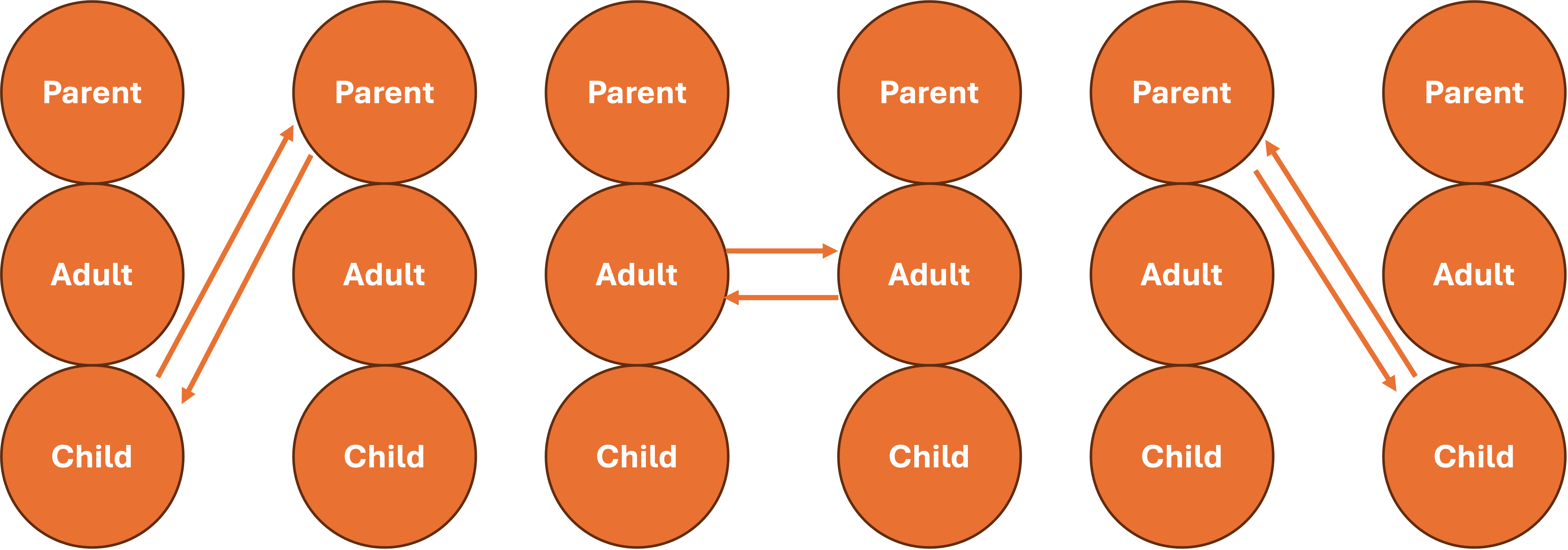
In TA, each interaction we make with someone else is termed a transaction. There are complementary, crossed, and ulterior transactions.
Complementary Transactions - These are the most psychologically stable and can continue indefinitely though the adult-to-adult state is seen to be the most productive for both parties. This could be one person stating “I’m stuck with this problem” (child), and another responding, “I’ll do it for you” (parent).
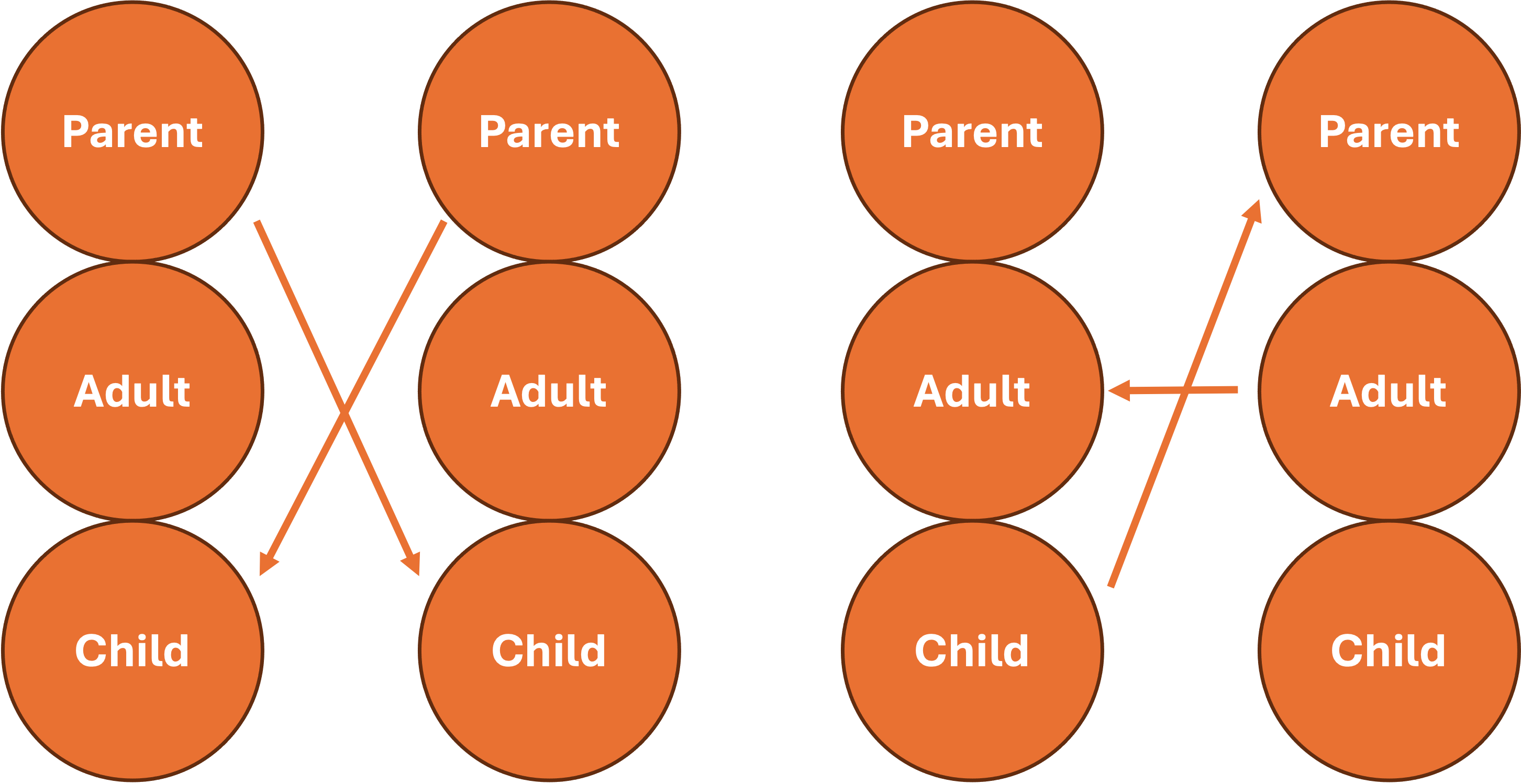
Crossed Transactions - These are much less stable interactions and will tend to only last until one shifts into a complementary state. This could be one person telling another off (parent), the other responding back “how dare you!” (parent), and the stalemate only shifts until one person gives way and apologises - most likely insincerely (child). The transaction on the right of the diagram below shows an attempt to avoid getting drawn into a “game” by appealing to the other’s adult state - more on this in a moment.
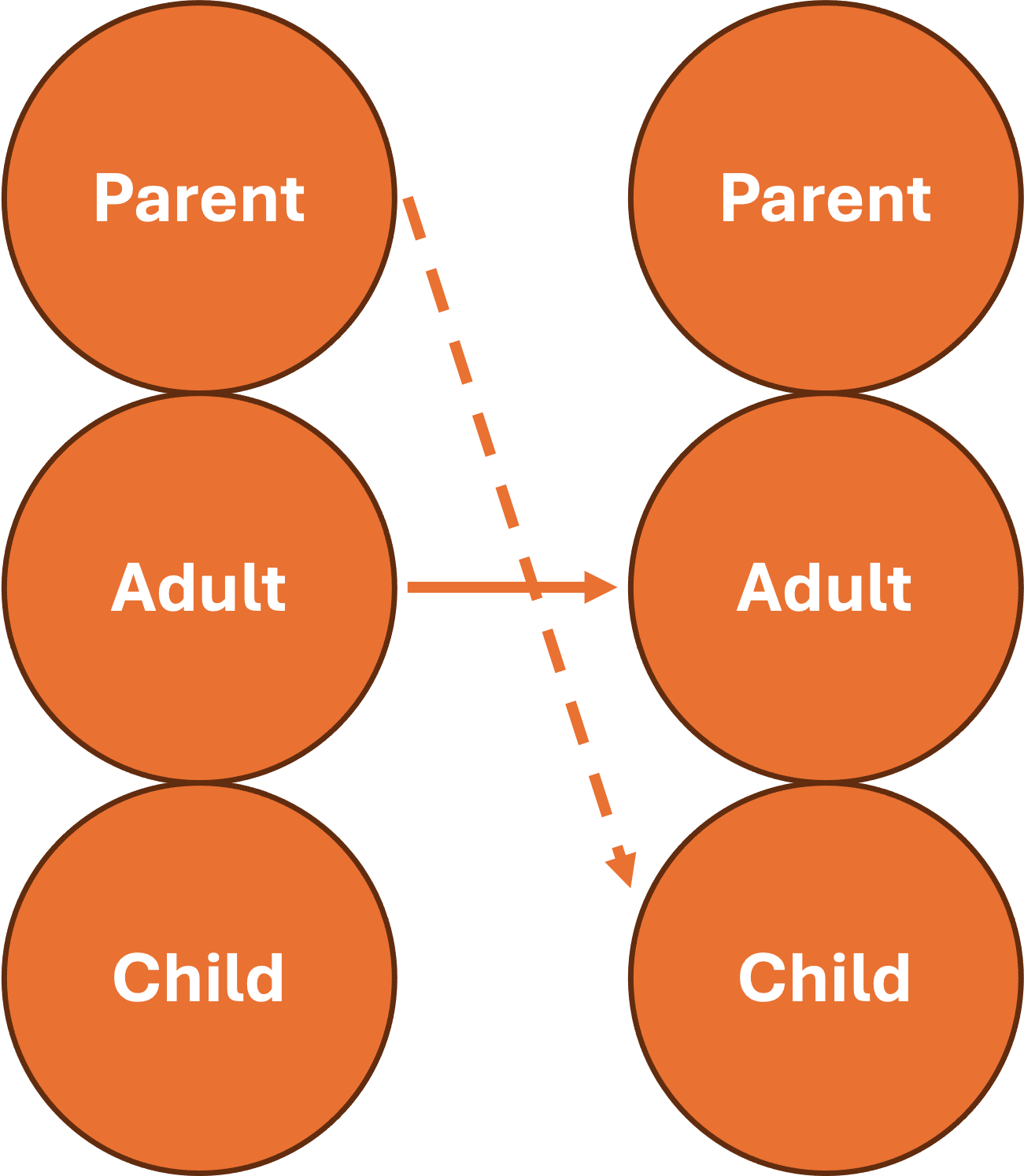
Ulterior Transactions - When something is said but something else is received. One example may be a boss asking why their employee is late by saying, “is everything alright at home?”. The employee interprets the question as a patronising suggestion that they need to sort their life out.
Games
Eric Berne coined many of the transactions people have as “games”,
“To say that the bulk of social activity consists of playing games does not necessarily mean that it is mostly ‘fun’ or that the parties are not seriously engaged in the relationship… games are substitutes for the real living of real intimacy.” (Berne, Games People Play)
There are many examples of games and to summarise them they often involve Rescuers, Persecutors, and Victims as can be found in The Drama Triangle. In each role we continue the game because it is either complementary to another person’s. For example, the over-nurturing parent always does things for the child (like tidying the child’s bedroom) with the “payoff” being that they’re always needed. The child responds in a complementary manner (leaves clothes on the floor) with the payoff that they remain comfortable and looked after. Both people don’t grow, but due to the complimentary states, they can remain “psychologically stable”.
These games can be very short or play out for years and the main strategy to avoid them is to respond from an adult state, appealing to the other’s adult state - which can in itself cause uncomfortable situations but in the long term helps promote personal growth. A good example of this would be the game “Yes but… why don’t you” as shown in the video by Theramin Trees below. The game is where one person seems to be asking for solutions to a problem and the second is continually giving solutions but none are being taken on board. There is always an excuse for why a solution isn’t appropriate. This game ends when the first person sarcastically states, “you’re a lot of help aren’t you!”
This is where a coaching question short-circuits the game. Instead of providing advice that will repeatedly be ignored, a coaching response gives the first person credit that they are an adult and can find a solution to their own problem. The response to a statement of “I can’t do this!” is a simple question, “what are you going to do about it?” This then moves the responder from Rescuer (Parent) to Coach (Adult) and the initiator from Victim (Child) to Creator (Adult).
Wrapping things up… for now
Using TA as a framework requires a fair amount of self-awareness and is best used as a way to recognise one’s own ego states rather than as a tool to judge others’. Stating that someone is in a parent or child state during a transaction is likely to come over as an overbearing parent!
I have found TA helpful for taking time to reflect on situations and interactions where I want to change my own behaviour. There will be further posts on its application and other models built from TA theory in due course. Hopefully for now, you can see the usefulness of the framework.
Here are a few questions to help you get started with reflecting from a TA perspective.
How do I respond when someone challenges me—logically, emotionally, or critically?
Do I notice myself switching ego states during conversations? What triggers the shift?
Do I tend to initiate complementary (smooth) or crossed (conflict-inducing) transactions?
Have I ever sent a mixed message (ulterior transaction)? What was I hoping to achieve?
In my recent communication, was I speaking from my Adult ego state or slipping into Parent/Child roles?
Do I feel comfortable expressing myself clearly, or do I often rely on sarcasm or hints (ulterior messages)?
Do I find myself in recurring conflicts or situations with others? Could these be psychological “games”?
What “payoff” might I be getting from these repeated patterns or roles I play (e.g., Victim, Rescuer, Persecutor)?
Let me know what you make of this post. Feel free to message or comment below.
Resources:
Counselling For Toads by Robert de Board

