


I’ve been delivering seminars on Cultural Intelligence (CQ) and cross-cultural interactions for 8 years and in many of them I highlight the fact that when you are navigating different cultures, conflict is going to happen. It isn’t really a case of ‘if’, but of ‘when’. While I still think this is true, I came across a post by another writer and researcher on culture reflecting on conflict where she writes,
“Whether a conflict exists at all is a cultural question. In an interview conducted in Canada, an elderly Chinese man indicated he had experienced no conflict at all for the previous 40 years. Among the possible reasons for his denial was a cultural preference to see the world through lenses of harmony rather than conflict, as encouraged by his Confucian upbringing. Labeling (sic.) some of our interactions as conflicts and analyzing (sic.) them into smaller component parts is a distinctly Western approach that may obscure other aspects of relationships.” 1
The ability to handle conflict is hindered if we don’t recognise culture as a major factor in our relationships - even when we are interacting with those who seem to have a similar cultural background.
In their book Smart Conflict2, Louise van Haarst and Alice Driscoll provide the 5-R Model of Smart Conflict (see figure below). The first ‘R’ being Reflection. As part of reflection, they highlight culture as a significant part of both the causes of a conflict and a key to understanding your default response. When we rely on default behaviours we can easily make the problem worse.
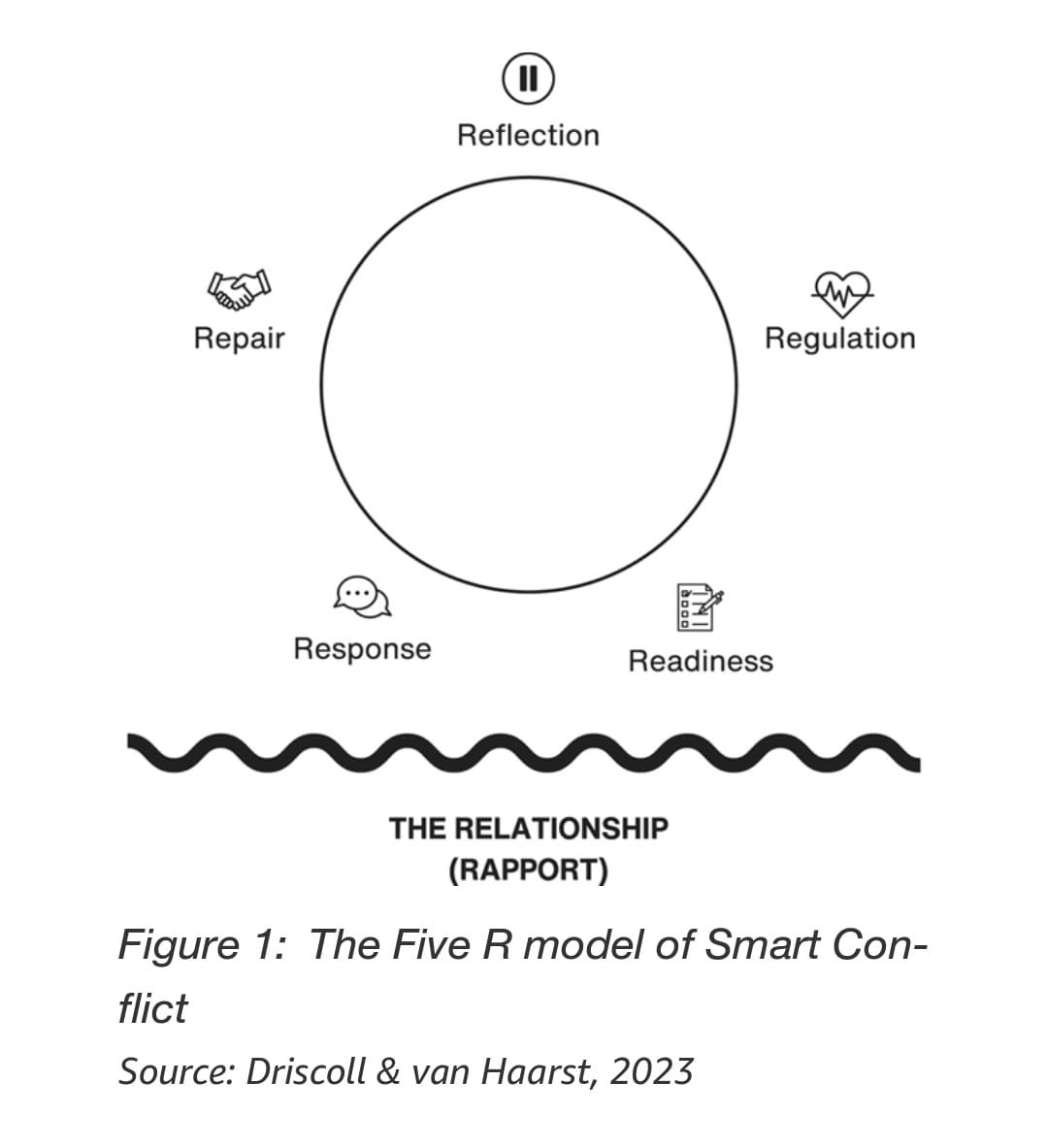
Our genetics, family, gender, upbringing/education, and communities we find ourselves in (all with their own cultural influences), all play a part in how we recognise and seek to resolve (or ignore!) conflict. If you want to be more effective in handling conflict then having the awareness to step back from a difficult moment to give time to reflect is a great first step. However, reflection shouldn’t be left to the moment conflict happens, building in a habit of reflection helps with developing emotional intelligence as well as cultural intelligence!
Take a moment to think about how you handle conflict.
Do you prefer to communicate directly so that everyone knows exactly how you feel?
Are you more inclined to avoid conflict, especially with those in authority positions so that all parties can save face?
Have you witnessed any conflicts that were handled well?
How do you handle disagreement?
These questions are just example starting points. Driscoll and van Haarst offer resources in their book for self-reflection as well as more detail on default conflict styles. You can also get in touch with me if you’d like some coaching on navigating conflict or cultural intelligence.
Further reflection may be need when it comes to the cultural aspects of a conflict. Reading through the previous posts on Cultural Intelligence may be helpful in highlighting different communication preferences.

As an example of where culture can cause conflict, think of someone with a High Context preference interacting with someone with a Low Context preference. Someone with high context will be more likely to be indirect in their verbal communication, avoiding confrontational or blunt language and relying on non-verbal cues as much as verbal ones. A low context preference tends to be more direct, valuing verbal clarity even if its difficult to hear. To the high context person, directness can be seen as rude or offensive and damaging to the relationship. To the low context person, indirectness can be seen as avoiding confrontation and may amplify misunderstanding due to an emphasis on non-verbal cues.
Revisiting the domains of culture as shown by Hofstede or Meyer highlights the various spectrums that people find themselves on, and when two different parts of any spectrum interact, there is a higher likelihood of a clash.
Being aware of your own cultural preferences is the start to recognising that other people have different ways of operating. Awareness of difference is one part of Cultural Intelligence and fits under the CQ Knowledge, but it takes more than just knowledge to navigate a conflict - we need CQ Strategy and CQ Action.
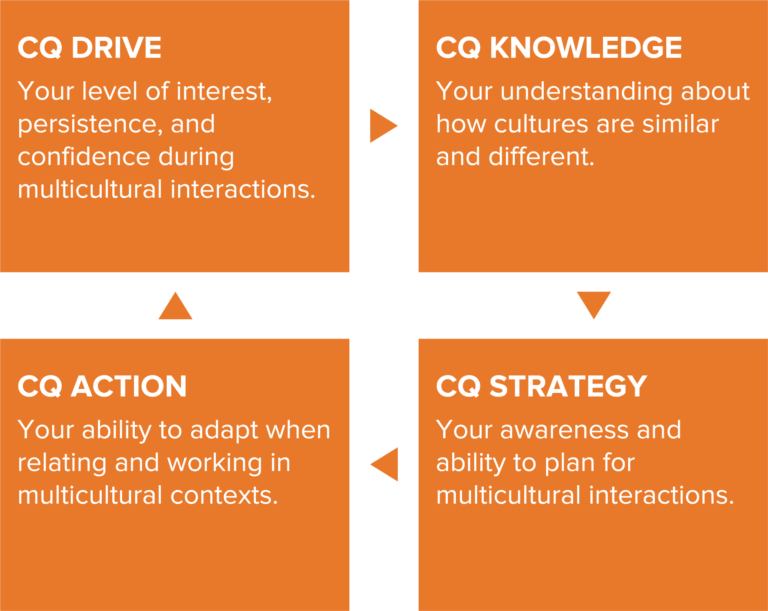
Working through the framework that Louise van Haarst and Alice Driscoll provide in their book, is helpful for navigating cross-cultural difference, just as much as a conflict situation. In this case, it will help us with moving from CQ Knowledge to Strategy and Action.
Relationship - the relationship is what lies under all the other aspects of the model and without it as the focus, the rest of the model falls apart. Our ability to build rapport with those around us will help provide the safety and goodwill that makes navigating conflict a bit less daunting. The authors highlight psychologist Carl Rogers’ three core conditions for personal growth and I think they are key to developing better cross-cultural relationships too:
Unconditional Positive Regards - accepting people without judgement
Empathy - understanding and reflecting their feelings
Congruence (or Genuineness) - being authentic rather than distant or impersonal.
If these three conditions are a part of how we engage with others, then we are laying the foundations for graciousness and goodwill that make hard conversations a little bit easier as people know you care for and about them, not just for what they can do for you.
Pause/Reflect - Check if the issue is due to your own preferences, cultural or otherwise. Hold back judgement that what has happened is right/wrong, and aim to remain curious. This allows you to ask questions to understand rather than make statements to “correct” the other person. Beyond your cultural awareness, this part also relies on your emotional self awareness.
Regulation - There is a lot of overlap between CQ and EQ. Regulation is making sure the emotional reaction to something that has offended you isn’t what drives your response in the conflict. I write more on this here:
Readiness - Once you’ve gone through the first two steps, you may find that you don’t need to say anything at all. You can see the interaction is more about your response than the other person’s behaviour and so you can decide to adapt your own behaviour rather than plan out a conversation. As Haarst and Driscoll note, there are also times where avoiding an outright conflict may be beneficial to all as no matter what you say, there will be no beneficial outcome. They provide two questions to ask yourself:
What am I trying to achieve by having this conversation?
Is my goal in having this conversation in service of something beyond myself and my own personal dissatisfaction?
Readiness requires further reflection which goes beyond the scope of this post but is all about overcoming personal barriers to managing the conflict such as anxiety and a framework for handling difficult conversations. It is also helpful to review your default communication style both in terms of directness and in terms of how you provide negative feedback (which differs across cultures!). See more in the post below:
Response - This part of the framework overlaps with what has already been said but there is an emphasis on safety both in terms of physical and psychological safety. If the other person is not open to a difficult conversation and responds overly physically, emotionally, or manipulatively, it is best to have an exit strategy. There are times where you removing yourself from a situation is the right response.
Conflict is difficult and often emotions come in to play when trying to work through actions and behaviours that have caused offence. Having a plan for how you might respond, including offering breaks to take a breather if emotions get to high, planning to remain curious rather than judgemental, and to keep the reason for the conversation that goes beyond your own personal issues that was made clear in step 3 at the forefront of your mind, if not written down.
Repair - As you might realise, each of these steps require more time and detail than I’m giving in this post. I highly recommend the book, Smart Conflict, and I’ll be digging further into conflict resolution and repair myself on this blog in due course. Repair does not mean a smoothing over and ignoring the past but a recognition the conflict or difficulty happened and learning from it. It also requires what relationship researchers Dr. John and Dr Julie Gottman call “bids for repair” - moments that highlight a desire to reconnect or friendship. It takes time for repair to happen and the Gottmans’ research suggests it takes up to 5 bids for repair for every time a relationship is ruptured. A rupture may not be a full-on conflict, but it highlights the importance of kindness and reconnection after a conflict to avoid further damage to a relationship.
As with all the other parts of this framework, recognition of culture is still important. Two questions to reflect on where your cultural brackground might be showing up:
Are you leaning hard on what you default to in terms of showing warmth and communicating friendliness?
Does the person you are trying to repair the relationship with need something different to what you assume?


Handling conflict well is a massive topic, however I hope the frameworks and ideas shared here provide an introduction into how culture influences the causes of, and the responses to, conflict. The vast majority of people I come across are wary of confrontation. Because we are relational beings, conflict is common and avoidance can often make it worse. However, by engaging with reflective practices, learning to develop our emotional and cultural intelligence, we can learn to navigate conflict in a way that improves the quality of our relationships and makes the most of the diversity around us.
If you’ve enjoyed this exploration on culture and conflict, subscribe to keep in the loop as I continue to write on culture and coaching.
Culture and Conflict by Michelle LeBaron; https://www.beyondintractability.org/essay/culture_conflict
Smart Conflict, Louise van Haarst and Alice Driscoll, https://www.amazon.co.uk/Smart-Conflict-have-hard-conversations-ebook/dp/B0FC72TC49/