

As those of you who have subscribed and receive my monthly newsletter know, I’ve recently started a Coaching Apprenticeship as part of my dual roles as a Chaplain at the University of Surrey and Staff Worker for Friends International. For some time I’ve been pondering a new qualification and many of you may have heard my thoughts on whether that looked like a masters in Counselling. Through conversations with a colleague in HR at UoS I was introduced to this apprenticeship in coaching and everything else seemed to fit into place in terms of time, finance, and personality.
What is coaching?
I’ve come across coaching multiple times in my working life having been coached as part of a group when I was teaching, and individually for a period of time as part of my work in Friends International. Both were invaluable and I still utilise some of the skills and resources learned during those sessions. I’ve heard many people use coaching in many different contexts but often the definitions are a bit blurred with those of mentoring, consulting, or counselling. I think the most helpful definition I’ve come across so far in the introductory sessions is, Timothy Gallwey’s:
“Coaching is unlocking a person’s potential to maximise their own performance, helping them to learn, rather than teaching them.”
Coaches do not lead or set the agenda, they simply ask questions the coachee can’t, or are reluctant to, ask themselves.
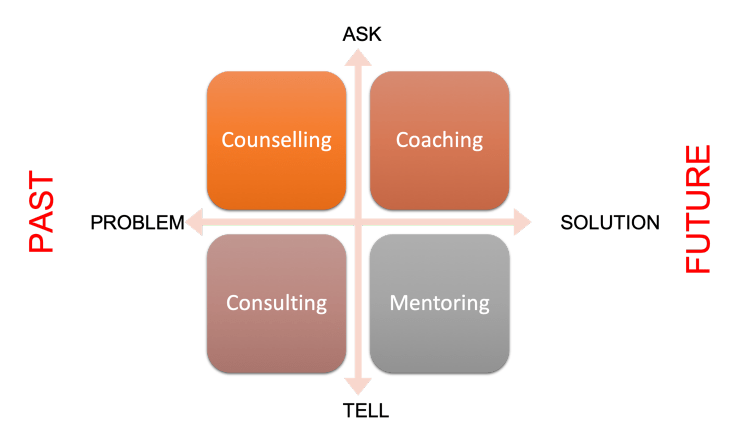
The following graphic highlights the differences between coaching, mentoring, counselling, and consulting and how it fits into providing support for people. All forms of support are valid but coaching provides a particular support that focuses on solving problems set by a client by drawing out solutions from the client, not telling or giving solutions from a place of experience as per mentoring or consulting.
So…why coaching?
I’ve found that the more I dig into what coaching is, the more I realise it is something I’ve done intuitively and something I find fulfilling. Whether it was through teaching, tutoring, pastoral care in church, supporting others going through or coming out of church messes, my role in supporting international students and staff, or just being a mate, I’ve learnt that asking questions is often far more helpful than giving direct advice. Once I recognised what it is, deepening my understanding of and gaining a qualification in coaching seemed to be a natural next step.
I’ll be aiming to share insights I’ve gained from my apprenticeship, my reflections on coaching theory, and hopefully begin to use this platform as something that will help others. If you are interested in being coached, whether it's linked to an important decision or work/life goal, get in touch as I’ll be looking for coachees to gain the required 50 hours of coaching time to complete the apprenticeship.
Interested in what coaching is or making use of coaching techniques yourself?
Well, feel free to subscribe…
I hope what I share will be helpful! As a starting point, here is a video shared on my course as an introduction to what coaching is and how anyone can start using coaching techniques to improve their relationships.